



Quick Answer: An SEO citation is any online mention of your business’s name, address, and phone number (NAP), usually on a directory, map app, review site, or website. It does not need a link back to your site to count. Search engines cross-check these mentions to confirm your business is real and located where you say it is, which makes citations one of the core building blocks of local SEO and the map pack.
Quick Answer
An SEO citation is any online mention of your business’s name, address, and phone number (NAP), usually on a directory, map app, review site, or website. It does not need a link back to your site to count. Search engines cross-check these mentions to confirm your business is real and located where you say it is, which makes citations one of the core building blocks of local SEO and the map pack.
You have probably heard that citations “matter for local rankings,” but nobody explains what actually counts as one, or why a listing on some random directory could help or hurt you.
Here is exactly what SEO citations are, the two types you need to know, and how to build them without creating problems for yourself later. If you are new to the wider topic, our guide to what SEO optimization is covers the basics first.
Table of Contents
The Basic Definition of an SEO Citation
A citation is any place online where your business’s NAP information appears. This includes formal directory listings, but it also includes a mention in a local news article, a blog roundup, a chamber of commerce page, or a “best of” list, as long as your business details are accurate.
The key difference from a backlink is that a citation does not require a clickable link. Google can still read and verify your business details from plain text. Citations are a signal for local search specifically, the results tied to a searcher’s location.
Structured vs. Unstructured Citations
Structured Citations
Structured citations are business listings on dedicated directory platforms, where your NAP sits in defined fields rather than free-flowing text.
Common examples include:
- Google Business Profile
- Bing Places for Business
- Apple Maps, managed through Apple Business Connect
- Yelp and Facebook business pages
- Industry directories such as Avvo (law), Healthgrades (medical), or Houzz (home improvement)
These are usually the first citations businesses build, since directory platforms actively ask for this information during setup. They are also the easiest to keep consistent, because each field is labeled.
Unstructured Citations
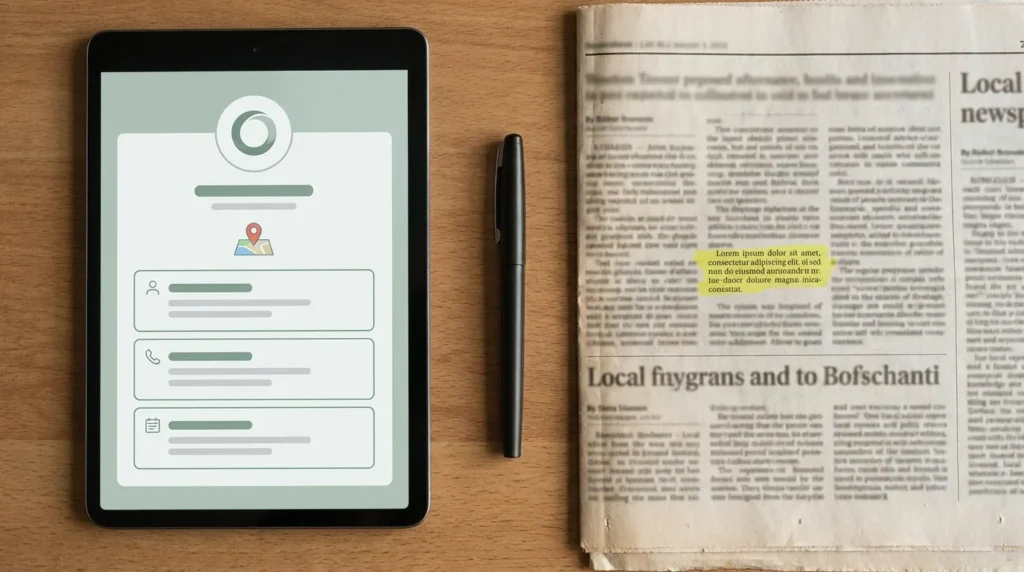
Unstructured citations happen when your business is mentioned naturally within written content, such as a news article, a guest post, a sponsorship page, or a community blog.
For example, if a local newspaper writes “XYZ Plumbing, based on Main Street, has served the area since 2015,” that is an unstructured citation, even without a link. These are harder to earn, which is exactly why they carry weight: they look organic rather than manufactured.
Why SEO Citations Matter for Local SEO
Search engines treat consistent citations across multiple platforms as a trust signal that your business is legitimate and accurately represented.
This matters most for Google’s local map pack, the three business listings shown for searches like “plumber near me.” Google cross-references citation data to verify your business exists at the location you claim, which reduces the risk of showing outdated or fake listings. AI assistants such as ChatGPT and Google’s AI Overviews also draw on the same directory data when they recommend local businesses, a shift we cover in Is SEO Dead?
Citations alone will not guarantee a top ranking. Google’s own guidance lists relevance, distance, and prominence as the main local ranking factors, and citations feed the prominence part. But without them, or with inconsistent ones, your local visibility usually suffers regardless of how good your website is.
Why NAP Consistency Is the Most Important Factor
If your business name, address, or phone number differs across listings, search engines struggle to confirm they are all referring to the same business.
Common inconsistencies that cause problems:
- An old phone number still live on a directory you forgot about
- A previous address from before you moved
- A suite number included on some listings and missing on others
- Different business name formatting, like “XYZ Plumbing LLC” versus “XYZ Plumbing” or a keyword-stuffed name on one platform
- “St” on one listing and “Street” on another
Google has become better at matching minor abbreviation differences like “St” and “Street,” so the last item is the least serious. Wrong phone numbers, old addresses, and mismatched names are the ones that do real damage. Fixing them is often the single biggest local SEO improvement a business can make, especially if listings were created years apart by different people.
Quality Over Quantity
Not all citations carry equal weight. A handful of accurate citations on relevant, reputable sites outperforms dozens of listings on low-quality, spammy directories. The same logic applies to links, as we explain in are backlinks still relevant.
Prioritize:
- Major platforms like Google Business Profile, Bing Places, and Apple Business Connect
- Industry-specific directories relevant to what you do
- Your local chamber of commerce and regional business directories
- Any site with genuine traffic and authority in your area, including local news and community organizations
Avoid mass-submitting your business to hundreds of unknown directories. Many of these sites have little to no traffic, and if the directory itself gets flagged by Google, your listing sits in bad company. For mosques and nonprofits, the same rule applies: a listing on the local Islamic council or interfaith network site is worth more than fifty generic directories. Our nonprofit and mosque support services cover this kind of local visibility work.
How to Find and Fix Existing Citations
Before creating new citations, check what already exists. Old, incorrect, or duplicate listings often do more damage than having no citation at all.
Search your business name plus your city in Google to see what is already indexed. Then search your phone number in quotation marks, which surfaces listings under old or misspelled names. Citation-tracking tools like Moz Local, BrightLocal, or Whitespark can scan for existing listings and inconsistencies automatically.

Once you find outdated listings, claim them where possible and correct the details. For listings you cannot access directly, most directories have a “suggest an edit” or “report an issue” option. Keep a simple spreadsheet of every listing, its URL, and the date you last checked it, so the next fix takes minutes instead of hours.
Citations vs. Backlinks: What Is the Difference?
These two get confused often, but they serve different purposes.
A backlink passes link authority from one site to another, which helps with overall domain strength. A citation verifies your business identity, even without a link, and mainly influences local search trust.
Many citations do include a link, which means they can contribute to both. Directory links are often nofollow, but as we explain in do nofollow links help SEO, that does not make them worthless. A citation without a link still holds value for local search, which is why it should not be dismissed just because it is not “linkable.”
Frequently Asked Questions About SEO Citations
How many citations does a local business need?
There is no magic number. Start with the major platforms and the five to ten directories that matter in your industry and city, then focus on keeping them accurate. Consistency across 20 good listings beats 200 careless ones.
Do citations still matter for SEO in 2026?
Yes, for local search. They remain one of the ways Google verifies a business exists, and AI answer engines pull from the same directory data when recommending local businesses.
Are citations a ranking factor?
Google does not publish a list of local ranking factors beyond relevance, distance, and prominence. Citations contribute to prominence and to Google’s confidence in your location data, so they influence rankings indirectly rather than as a direct score.
Does a citation need a link to count?
No. A plain-text mention of your name, address, and phone number is a citation. A link is a bonus, not a requirement.
How often should I audit my citations?
Check them whenever your details change, and do a full audit at least once a year. Old listings have a habit of resurfacing.
Get Your Local Listings in Order
SEO citations are the least glamorous part of local SEO and one of the highest-return fixes for a small business. Correct them first, then build the rest of your SEO improvement plan on top. If you would rather have someone audit and fix your listings for you, explore Halal Outreach’s SEO and marketing services or book your consultation.
Need help with SEO, ads, or a new website?
Get a Free Consultation →