


| Quick answer SEO optimization means making a website easier for Google to find, understand and trust, so it appears higher in search results when people look for what you offer. The work splits into three branches: on page (your content), technical (your site’s health) and off page (your reputation elsewhere). Nothing about it is a trick. Google rewards pages that genuinely answer searches, load properly and come from credible sites, and SEO is the craft of meeting those three standards deliberately instead of by accident. |
If you have ever received an SEO quote and understood none of it, this page is for you. SEO optimization has a jargon problem, partly because complexity sells retainers, and a business owner who cannot explain what they are buying cannot evaluate it either. So here is seo explained simply: what the work is, how Google actually operates, and what separates real SEO from theatre. When you are ready to act on it, our pillar on how to improve SEO turns this understanding into a plan.
Table of Contents
One clarification first, because the phrasing confuses people. SEO already stands for search engine optimization, so SEO optimization is technically saying optimization twice. Everyone searches it anyway, and it means the same thing: the ongoing work of improving a site’s search presence. If you are comparing that work as a purchased service, we have broken down what SEO services and types exist separately; this page explains the thing itself.
SEO in one paragraph
Google’s business is answering searches well. Your website either helps Google do that or it does not. SEO optimization is everything you do to become the answer Google wants to show: writing pages that resolve real searches, keeping the site fast and readable for machines, and building the kind of reputation that makes Google confident recommending you. That is the entire subject. Every tactic you will ever hear about is one of those three sentences wearing a costume.
How Google actually works: crawl, index, rank
Understanding three words removes most of the mystery, because every SEO problem lives at one of these three gates, and each gate only matters if the page passed the one before it.
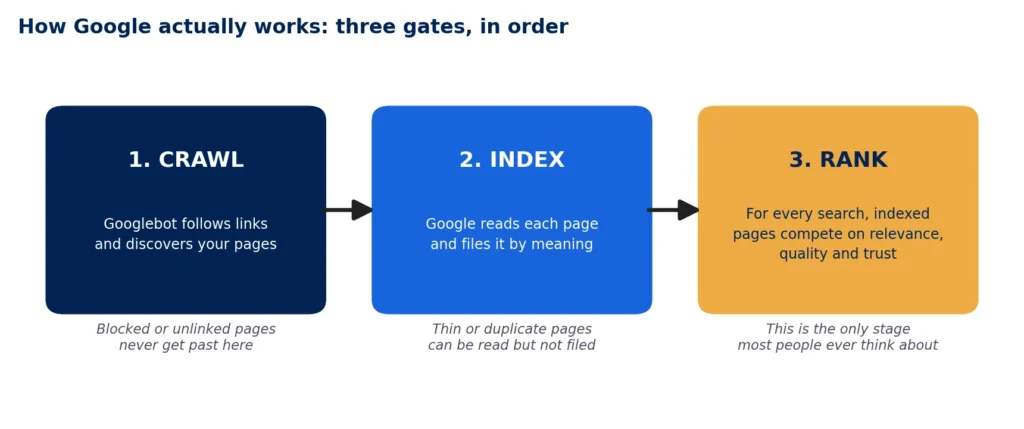
Crawling, indexing and ranking. A page that fails an early gate never reaches the later ones, whatever its quality.
Crawling is discovery: Googlebot follows links from page to page, finding what exists. Indexing is filing: Google reads each discovered page and stores what it is about. Ranking is the competition: for every single search, Google pulls candidates from the index and orders them by relevance, quality and trust.
Why this matters to you: when a page gets no traffic, owners almost always assume a ranking problem and start rewriting content. Often the page was never indexed at all, or never crawled, and no amount of rewriting fixes a gate it has not reached. The free Google Search Console tells you exactly which gate a page is stuck at, which is why it is the first tool anyone doing SEO should open.
The three branches: on page, technical, off page
All SEO work sorts into three branches, and an honest provider can tell you which branch any line of their quote belongs to. Technical work sounds intimidating but much of it is mundane, things like the page speed improvements a developer can make or simply clearing a bloated WordPress cache. Here is the full map:
| Branch | What it covers | Everyday examples | Who typically does it |
|---|---|---|---|
| On page | Everything on your pages that humans and Google read | Titles, headings, content depth, internal links, images | You, a writer, or your SEO provider |
| Technical | Whether machines can access and read the site properly | Speed, mobile display, indexing, HTTPS, site structure | A developer or technical SEO |
| Off page | Your reputation beyond your own site | Links from other sites, reviews, mentions, local listings | Earned over time, hardest to buy honestly |
The branches also explain pricing. On page work scales with how many pages you have, technical work is heavily front loaded, and off page work is slow and ongoing by nature. A quote that is all off page link building for a site with thin content and technical problems has the order backwards, and now you know enough to notice.
What Google rewards in 2026
Google publishes more about this than people assume, and the direction of every recent update is the same: reward pages that demonstrate real experience and answer the search completely, demote content produced at scale to fill space. In practice, the pages winning today share three traits. They match the intent of the search rather than just its words. They show first hand knowledge, meaning specifics, examples and evidence a generic writer could not fake. And they sit on sites that are fast, coherent and trusted. We keep a fuller breakdown in how to improve website ranking on Google, but those three traits are the spine of it.
The newest wrinkle is AI search. Google’s AI Overviews and assistants like ChatGPT now answer many questions directly, quoting sources rather than just listing links. That punishes shallow definition pages hardest and rewards exactly the same things classic SEO rewards: clear direct answers, genuine expertise and trustworthy sites. Optimizing for AI answers is not a separate discipline, whatever the new wave of consultants selling it claims. It is the same work with the same winners.
What no longer works
Half of SEO’s bad reputation comes from tactics that died years ago but are still being sold. These myths survive because each one genuinely worked a decade ago. If a quote leans on any of these, walk away:
| The tactic | Why it is dead | What replaced it |
|---|---|---|
| Keyword stuffing | Google reads meaning, not repetition, and has since 2013 | Covering the topic fully in natural language |
| Buying bulk backlinks | Link schemes are ignored at best, penalised at worst | Earning links with content worth citing |
| Mass directory submissions | Generic directories passed value fifteen years ago | A handful of genuine local and industry listings |
| Spinning hundreds of thin pages | Scaled low value content is a named target of recent updates | Fewer pages with real depth |
| Exact match domains as a trick | The name bonus is long gone | A brand people remember and search for |
| Guaranteed rankings | Nobody controls Google, so the guarantee is the red flag | Honest timelines and measurable progress |
What SEO cannot do
The no sugar coating section. SEO cannot rescue a business people do not want: if the offer is weak, ranking first just shows more people a weak offer. It cannot work in weeks; a realistic first year starts slow and compounds, and anyone promising page one in thirty days is selling either a keyword nobody searches or a shortcut that will not survive the next update. It cannot guarantee position one for a chosen keyword, ever, because Google alone decides. And it cannot replace marketing entirely: search only reaches people already looking, so it captures demand rather than creating it.
None of that makes SEO weak. It makes it specific: the highest leverage channel for capturing existing demand, and the wrong tool for everything else. Providers who say so upfront are the ones worth talking to.
How to evaluate an SEO quote
You now know enough to interrogate any proposal. Ask which branch each deliverable belongs to. Ask which gate, crawling, indexing or ranking, each fix addresses. Ask for the expected timeline in months, not weeks. And ask what happens to the work if you leave: real SEO builds assets you keep, pages, structure and reputation, while theatre builds reports. For the money question, whether the price is worth paying at all for a business your size, read our candid piece on whether SEO services are worth it before you sign anything.

And if you want the other side of the table to just talk straight: that is our whole pitch. We explain everything we do in plain language, exactly like this page, and you can test that claim in one phone call. See our services for what an engagement covers, or ask us anything on (949) 518-3350, including questions about a quote someone else gave you.
Frequently asked questions
What is SEO optimization?
SEO optimization is the work of making a website easier for Google to find, understand and trust, so it ranks higher when people search for what you offer. It covers your content, your site’s technical health, and your reputation on the wider web.
What does SEO optimization mean in simple terms?
The plain seo optimization meaning: Google wants to show searchers the best answer, and SEO means deliberately becoming that answer. Write pages that resolve real searches, keep the site fast and readable, and build a reputation Google can trust. Everything else is detail.
What do crawling, indexing and ranking mean?
Crawling is Google discovering your pages by following links. Indexing is Google reading and filing what each page is about. Ranking is the competition among indexed pages for each search. A page must pass each gate in order, and most invisible pages are stuck at crawling or indexing, not ranking.
What is the difference between on page, off page and technical SEO?
On page SEO is everything on your own pages: content, titles, headings and internal links. Technical SEO is whether machines can access and read the site: speed, mobile, indexing. Off page SEO is your reputation elsewhere: links, reviews and mentions. Real SEO work touches all three in that order.
Is SEO dead now that AI answers questions?
No. AI Overviews and chat assistants pull their answers from the same index, and they cite sources that demonstrate expertise and trust. Shallow content is losing visibility, but that was already true. The sites AI systems quote are the sites doing classic SEO well.