

| Quick answer Nonprofit digital marketing is the work of reaching donors, volunteers and beneficiaries through owned online channels: your website, email list, search presence and social accounts. For a small organization, the highest return sequence is a working donation page first, an email list second, the Google Ad Grant third, and social media last. You do not need a large budget to do this well. You need a clear donor journey, roughly ten focused hours a week, and the discipline to measure donations rather than likes. |
Most advice on digital marketing for nonprofits is written for organizations with a communications department. If you run a small nonprofit, a mosque or a community organization, you probably have one person doing this work part time, a budget that would not cover a single corporate campaign, and a board asking why donations are flat. This guide is built for that reality. It is the strategic companion to our tactical list of nonprofit marketing ideas, and it covers the decisions that come before the tactics.
One thing to be clear about upfront: nonprofit marketing strategy is not business marketing with the prices removed. The economics, the audiences and the emotional stakes are different, and copying commercial playbooks is the single most common way small organizations waste their limited hours. It is also why audience engagement strategies that work for brands often fall flat for causes.
Why nonprofit marketing is different from business marketing
A business sells a product to the person who benefits from it. A nonprofit asks one person to pay so that a different person benefits. That single structural difference changes everything downstream.
First, your donor gets nothing tangible. The product is trust plus evidence of impact, which is why social proof carries far more weight in nonprofit marketing than in commerce. Testimonials from beneficiaries, photographs of real work, published financials and named board members are not decoration. They are the product page.
Second, your audiences are plural. A business has customers. You have donors, volunteers, beneficiaries, grant makers and community members, and a message written for one often reads wrongly to another. Volunteer marketing, for example, sells belonging and purpose, while donor appeals sell outcomes and urgency. One email cannot do both jobs well.
Third, budget constraints are permanent, not a phase. A business that finds a profitable channel pours money into it. A nonprofit that finds a working channel usually cannot scale spend, so the leverage has to come from owned assets that compound: an email list, search rankings, and a base of past donors who give again. Rented reach, which is what social media algorithms sell you, compounds for the platform rather than for you.
The channels that work when the budget is tiny
Every channel works for somebody. The question for a small organization is return per hour, because hours are the currency you are actually spending. Here is the honest comparison we give clients:
| Channel | Money cost | Time cost | Best for | Honest weakness |
|---|---|---|---|---|
| Email list | Low, often under $30 monthly | 2 to 3 hours weekly | Repeat donations, event turnout | Slow to build from zero |
| Website and donation page | Hosting plus setup | Front loaded, then light | Converting every other channel | Neglect quietly kills conversions |
| Google Ad Grants | Free, up to $10,000 monthly ad credit | 3 to 4 hours weekly to run well | Search visibility, program awareness | Strict rules, most accounts underuse it |
| Organic social media | Free | High and never ending | Community warmth, volunteer marketing | Weak at direct donor acquisition |
| SEO and content | Free if written in house | High upfront, pays for years | People searching for your cause | Six months before results show |
| Paid social ads | Real money, $300 plus monthly to matter | Moderate | Event promotion, retargeting | Costs rise, results stop when spend stops |
Time and cost bands reflect what we see across small nonprofit clients. Your numbers will vary with list size and cause type.
Read the table with one lens: which of these still produces value in month thirteen if you stop feeding it in month twelve? Email, your website and search content keep working. Paid ads and social reach stop the day you stop. Small organizations should build the first group before renting the second.
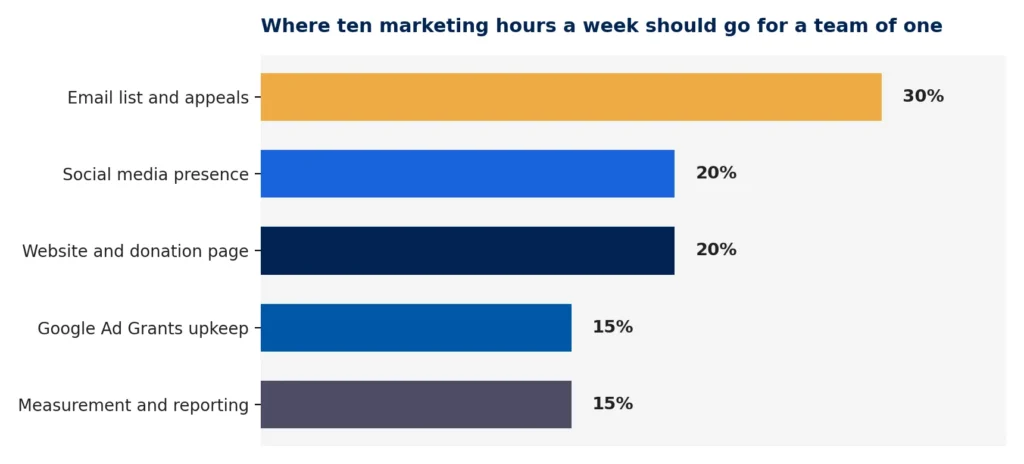
Our recommended starting allocation for a single person spending ten hours a week on marketing. Adjust once your own data disagrees.
Google Ad Grants: the $10,000 a month most nonprofits waste
Google gives eligible nonprofits up to $10,000 per month in search advertising credit through the Ad Grants program. That sentence sounds too good to be true, so here is the honest version: most organizations that get the grant use a fraction of it, and many lose it entirely for breaking rules they never read. The program requires a functioning website, ongoing account activity, a minimum 5 percent click through rate, with temporary suspension after two consecutive months below it, and campaigns that actually relate to your mission. Google also changes its advertising rules regularly, which is why we keep a running summary of recent Google Ads updates for clients.
The grant is genuinely valuable when it is pointed at the right pages. Sending grant traffic to your homepage is the classic waste. Sending it to a program page, an event registration or a well built donation page turns free clicks into names on your email list and, eventually, donors. Treat the grant as a donor acquisition engine that feeds your owned channels, not as a vanity traffic source.
Two warnings we give every client. First, the grant does not allow single word keywords, most branded terms belonging to others, or keywords with quality scores of one or two, so keyword hygiene is weekly work rather than a setup task. Second, grant ads lose most auctions against paid advertisers for commercial terms. Aim the grant at informational searches about your cause, where competition is thin and intent is real.
A donor journey, mapped simply
Channels only make sense when you know what job each one does. The simplest useful map has four stages, and every stage has one owner. Notice that the website appears twice, which is why the most important things a website needs is not a design question but a fundraising question.
| Stage | What the person is doing | Channel that owns it | The one metric |
|---|---|---|---|
| Discover | Hears of you: search, a friend, a shared post | Ad Grants, SEO, social media | New site visitors |
| Trust | Checks you are real: reads about page, sees proof | Website, testimonials, financials | Pages per visit |
| First gift | Donates once, usually a small amount | Donation page, event, appeal | Donation conversion rate |
| Repeat and advocate | Gives again, volunteers, tells others | Email list, personal thanks | Second gift rate |
The stage most small organizations ignore is the last one, and it is the expensive mistake. Acquiring a new donor costs real money and hours. A donor who gives a second time costs almost nothing and is far more likely to keep giving. If your only marketing activity this quarter is a proper thank you and follow up sequence for existing donors, that is a defensible strategy.
Email: still the highest return nonprofit channel
Email looks unfashionable next to social platforms, and it outperforms them anyway. You own the list, delivery does not depend on an algorithm, and the people on it have already raised their hands. Across our nonprofit clients, email consistently drives more donations per hour invested than every other channel, which matches what large sector benchmarks report year after year. If you only build one marketing asset, build the list, and use email marketing automation so the repetitive parts run without you.
What a small organization actually needs is modest. One welcome sequence of three messages for new subscribers. One monthly update that shows work, not activity, meaning photographs and outcomes rather than meeting summaries. Two to four appeals a year, each asking clearly for one thing. That is the whole machine. Organizations fail at email not because it is complicated but because they treat the list as a place to make announcements instead of a relationship with people who fund the mission.

Growing the list is slower than buying reach, and that is fine. Put a signup form on every page, collect emails at every physical event, and offer something small and genuinely useful for signing up. A mosque client of ours grew from zero to a list that reliably fills events using nothing but a form at the door and a monthly email people actually enjoy reading. No budget was involved.
Social media without a full time person
Here is the honest position, and it is not the one social media consultants will give you: organic social media is a trust channel, not a donor acquisition channel. Platform algorithms show your posts to a small slice of your own followers, and the slice shrinks every year. Posts asking for money perform worst of all. If you measure social media by donations generated, it will lose to email every single month. Our guide to social media best practices goes deeper on platform mechanics.
So why be there at all? Because donors check you before giving, and a dead account reads as a dead organization. Because volunteer marketing genuinely works on social, since belonging is visual and shareable in a way that bank transfers are not. And because community warmth, the sense that real people do real work, photographs well.
The sustainable version for a team of one: pick one platform where your community already is, post two to three times a week, and let the content be documentation rather than production. Photos from the food drive beat designed graphics. A volunteer speaking for thirty seconds beats a produced video that took a week. Repurpose everything into your monthly email, where the same content actually converts.
Measuring what matters beyond likes
Vanity metrics are numbers that go up without money following them. Small organizations drown in them because platforms serve them for free. The discipline is to track a short list of numbers that connect to donations, and we cover the full framework in marketing ROI metrics that matter. The short version fits in one table:
| Track this | Ignore this | Why |
|---|---|---|
| Donation conversion rate on your donation page | Total page views | Views without gifts mean the page is failing |
| Email list growth and open rate | Social follower count | You own one of these numbers |
| Second gift rate within 12 months | Likes and shares | Retention is where nonprofit economics live |
| Cost or hours per new donor | Impressions | Hours are your real budget |
| Ad Grant clicks reaching a goal page | Ad Grant total clicks | Unfocused grant traffic is free and worthless |
A note on search: ranking for the questions your community actually types is the cheapest discovery channel you will ever have, but it is slow and it is technical enough that many organizations either ignore it or overpay for it. Before hiring anyone, read our plain explanation of what SEO services actually include so you can tell a real proposal from a retainer that bills for reports.
When to bring in outside help
You do not need an agency to start. Everything above can be run by one organized person with ten hours a week, and the organizations that thrive digitally almost always started exactly that way. Bringing in help too early buys you deliverables without direction.
Outside help earns its cost in three specific situations. When the Ad Grant is approved but unused or at risk, because grant management is rule heavy and penalty prone. When your donation page converts poorly and you cannot diagnose why, because conversion problems are usually invisible to the person who built the page. And when the marketing hours simply do not exist on your team, because a channel run at zero hours produces zero, and admitting that early is cheaper than a year of drift.
This is the work we do daily for mosques, Islamic schools and community nonprofits. You can see exactly what is included on our nonprofit and mosque services page, and if you want a straight assessment of where your ten hours should go, book a free consultation or call (949) 518-3350. We will tell you honestly if you do not need us yet.
Frequently asked questions
What is nonprofit digital marketing?
Nonprofit digital marketing is the use of online channels, mainly a website, email, search and social media, to attract donors, recruit volunteers and reach beneficiaries. It differs from business marketing because the payer and the beneficiary are different people, which makes trust and social proof the core product.
How much should a small nonprofit spend on digital marketing?
Many small organizations can operate effectively on under $100 per month in tools, because the Google Ad Grant supplies up to $10,000 monthly in free search advertising and email platforms are cheap at small list sizes. The real spend is time: plan for roughly ten focused hours a week.
What is the Google Ad Grant and who qualifies?
The Google Ad Grant gives eligible registered nonprofits up to $10,000 per month in search ad credit. You need valid charity status, a working website and ongoing compliance with program rules, including a minimum 5 percent click through rate. Most grant accounts are underused rather than maxed out.
Which digital marketing channel is best for donor acquisition?
For first contact, search is strongest, through the Ad Grant and organic rankings, because it reaches people already looking for your cause. For converting and keeping donors, email outperforms everything. Organic social media is weakest for donor acquisition and works better for trust and volunteer recruitment.
Does social media actually raise money for nonprofits?
Directly, very little. Organic reach is small and shrinking, and fundraising posts reach the fewest people. Social media earns its place by making your organization look alive and trustworthy when donors check you, and by recruiting volunteers. Route the attention it creates into your email list, where donations actually happen.