



Quick Answer
Yes. Google confirms in its Business Profile Help that more reviews and positive ratings can help a business’s local ranking. Reviews feed the “prominence” factor, which affects the local pack and Google Maps results, not standard organic web rankings. The signals that matter are review count, average star rating, how recently reviews arrive, and what customers write in them.
Google rarely confirms ranking factors in writing, but reviews are an exception. That makes them one of the most reliable levers in local SEO, the practice of improving a business’s visibility in location-based searches such as “plumber near me”.
The effect applies to local results, not classic organic web rankings. Four review signals carry weight:
- Total review count
- Average star rating
- Review recency
- Text content within reviews
Table of Contents
What Google Confirms About Reviews and Local Ranking
Google ranks local results mainly on three factors: relevance, distance and prominence. Reviews sit inside prominence, which Google describes as how well-known a business is. Google says prominence draws on information such as how many websites link to your business and how many reviews you have, and that more reviews and positive ratings can help your local ranking.
No equivalent statement exists for organic web results, which is the distinction most businesses miss. Google also states that there is no way to request or pay for a better local ranking.
Local Pack vs Organic Rankings
Reviews influence the local pack, the map result showing three businesses for searches with local intent. They do not directly influence the standard blue-link organic listings below it.
This matters for how you allocate effort:
- Local pack and Google Maps: reviews are a confirmed ranking factor.
- Organic rankings: reviews help only indirectly, through click-through rate, trust and brand searches. For organic results, focus on the steps in our guide on how to improve SEO.
- Service-area businesses: a stronger review profile can help offset a distance disadvantage against closer competitors.
Distance still matters, but a business slightly further from the searcher can outrank a closer one when its review profile and overall prominence are significantly stronger.
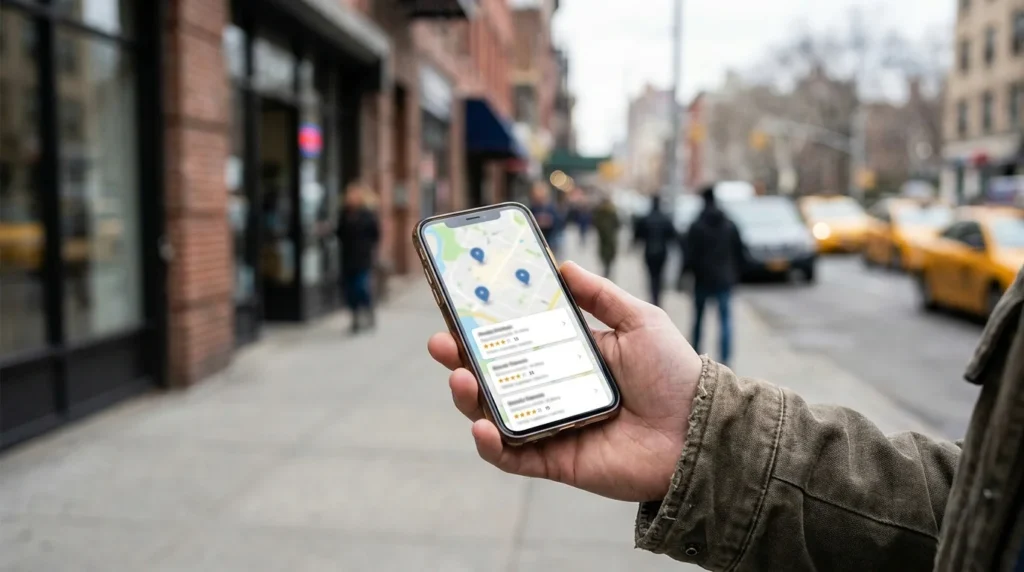
Review Count: Benchmark Against Your Local Competitors
Volume builds prominence. Compare your total against the businesses currently ranking in your local pack for your target search, not against a national benchmark.
Check the top three results for your main keyword, record their review counts, and set your target above the median of those three. If you are unsure which searches to benchmark, start with how to find good keywords for SEO. A plumber competing against businesses holding 40 to 60 reviews needs a different target than one competing against businesses holding 400.
Star Rating: Why 4.8 Beats 4.2 (and 5.0 Is Not the Goal)
Average rating affects both ranking and click-through. Google confirms that positive ratings help local ranking, and searchers comparing a 4.2-star profile with a 4.8-star profile in the same results tend to click the higher one.
Do not chase a perfect 5.0. A profile showing only five-star reviews and no criticism can look less credible to customers, and a mix of genuine ratings reads as more trustworthy.
Review Recency: Steady Beats Sudden
A profile holding 200 reviews with the most recent dated 18 months ago suggests a business that has stopped operating or stopped serving customers well. Steady arrival matters more than a single burst.
Target a consistent monthly rate rather than a one-off campaign. Google’s policy specifically targets content showing unusual volumes or patterns of reviews, so twenty reviews spread across ten months are safer and more natural than twenty arriving in one week.
Keywords in Review Text: What You Can and Cannot Ask For
What customers write can reinforce relevance. When reviews naturally mention a service or location, such as a boiler replacement in Kent, they help describe what your business does and where. Google can also highlight phrases from reviews on your profile.
However, Google’s policy states that businesses should not request that specific content be included in a review. You cannot script reviews or tell customers which keywords to use. You can make detailed reviews more likely:
- Ask for honest feedback about their experience, without suggesting wording
- Send the request within 48 hours, while the details are fresh
- Send separate requests for separate services, so each customer reviews the job they actually received
Responding to Reviews
Google encourages businesses to reply to reviews, since replies show customers you value their feedback. Replies also add fresh, relevant text to your profile and demonstrate active management.
Apply three rules:
- Respond to every review, including positive ones
- Aim to respond within 72 hours
- Mention the service naturally where it fits, without stuffing keywords
For negative reviews, respond once with a calm, factual reply and an offline contact route. Extended public argument damages conversion more than the original review did. Good replies are part of wider audience engagement that builds long-term trust.
Review Practices That Break Google’s Policies
Google’s Maps content policy prohibits fake engagement and removes violating reviews. Businesses caught manipulating reviews can face review removal, temporary blocks on new reviews and, in some regions, warning labels on their profile. Avoid these practices:
- Buying reviews. Reviews paid for directly or in kind are prohibited, and removal can be retroactive.
- Review gating. Selectively asking only satisfied customers for reviews, or discouraging negative ones, violates Google’s policy directly.
- Incentivised reviews. Offering payment, discounts or free goods or services in exchange for a review is prohibited.
- Conflict-of-interest reviews. Reviews from current or former employees, family members, contractors or competitors breach the policy.
- Requesting specific wording. Asking customers to include particular keywords or content is not allowed.
- Unnatural spikes. Sudden bursts of reviews that look like rating manipulation can be filtered.
Losing reviews or having restrictions placed on your profile costs far more than the reviews were ever worth. The same principle applies to links, which we cover in are backlinks still worth it: shortcuts get caught.
How to Get More Google Reviews

Build the request into your existing process rather than running periodic campaigns:
- Get your review link from your Google Business Profile using the “Ask for reviews” option
- Send it by SMS or email at the moment the job is completed or the invoice is paid
- Include the link in email signatures, on printed invoices and on your website
- Train staff to ask politely, without pressuring customers to review on the spot
Ask every customer, not only the ones you expect to respond positively. Selective asking is review gating. Reviews work best alongside consistent business listings, so also check your local SEO citations and make sure your website is ready to convert the visitors your profile sends.
Need help with SEO, ads, or a new website?
Get a Free Consultation →Frequently Asked Questions
Do reviews on Yelp and Facebook affect Google rankings?
Possibly, but less directly. Google says prominence is based on information it has about a business from across the web, so third-party reviews may contribute. Reviews on your own Google Business Profile are the confirmed signal.
How many Google reviews do I need to rank?
No fixed threshold exists. Benchmark against the three businesses currently ranking in your local pack for your target keyword, then aim for a count above their median.
Do negative reviews hurt my ranking?
A small share of negative reviews is normal and can make a profile look more credible. A consistently low average rating, however, weakens both ranking and click-through, because Google confirms that positive ratings help local ranking.
Can I remove a bad Google review?
Only if it violates Google’s content policies, for example spam, off-topic content or a conflict of interest. You can report it from your Business Profile. Genuine negative experiences are not removed, so reply professionally instead.
How long until new reviews affect my ranking?
There is no official timeframe. Changes typically appear over several weeks, so track your SEO results and local pack positions over time rather than day to day.
Turn Your Reviews Into More Local Customers Reviews are one of the few ranking factors Google openly confirms. Ask every customer, reply to every review, and never take policy shortcuts. Need help with your Google Business Profile and local SEO? Contact Halal Outreach and our team will review your local search presence.