



Quick Answer
To use social media for e-commerce, connect a product catalogue feed to each platform, install pixel and server-side conversion tracking before you spend on ads, tag every link with UTMs, and treat most platforms as discovery channels that send buyers to your own checkout. Meta discontinued native checkout on Facebook and Instagram Shops on 4 September 2025, so purchases now complete on your website. TikTok Shop is the main platform that still sells in-app.
Social commerce has changed more in the past eighteen months than in the five years before it, and most guides online still describe a setup that no longer exists. This article walks through the current, working method step by step. If you’d rather hand the whole setup to a team that does it every week, Halal Outreach’s social media services cover catalogue setup, content, and paid campaigns under one roof.
For a wider definition of how social platforms support buying and selling, see the Wikipedia entry on social commerce.
The setup runs to six steps:
Each step is covered below, followed by creator content, measurement, and FAQs.
Table of Contents
Step 1: Connect the Product Catalogue First
Every shoppable feature depends on a product catalogue, so build this before posting anything.
- Meta Commerce Manager accepts a feed by scheduled URL, manual upload, or a platform integration from Shopify, BigCommerce, or WooCommerce
- Pinterest uses a very similar feed specification for Product Pins, so the same file usually works with minor field changes
- TikTok Shop requires its own catalogue connection through TikTok Seller Center
Reuse your Google Merchant Center feed rather than building a second one. The required fields overlap almost entirely, which removes a recurring maintenance task. Not sure which platform your store runs on, or whether it supports a feed export? Our guide on how to tell what platform a website is built on covers the quick checks.
Set the feed to refresh at least daily. Stale pricing and out-of-stock items generate disapprovals and wasted ad spend.
Step 2: Configure Your Checkout URL (Meta Shops Now Send Buyers to Your Site)
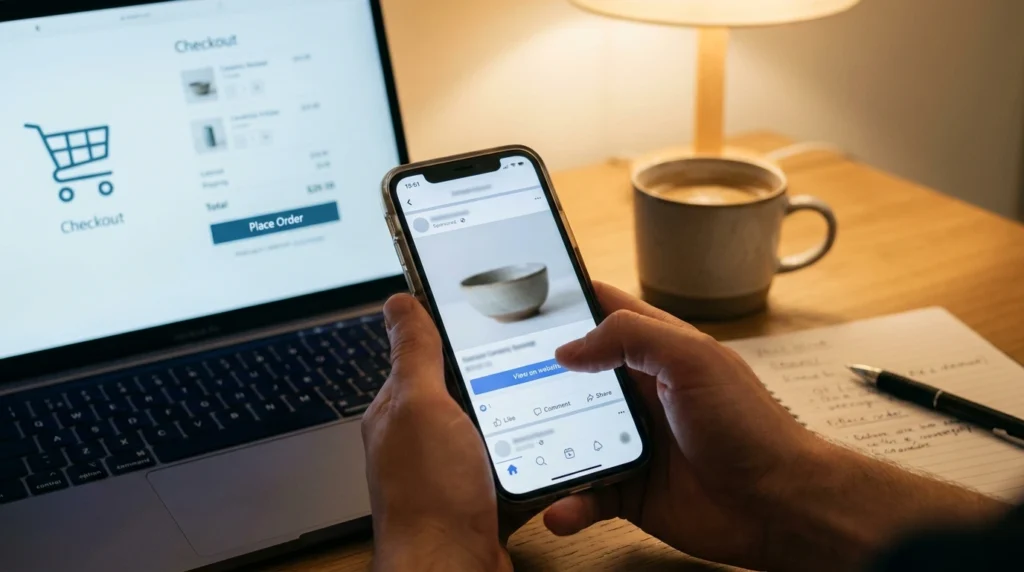
This changed recently and most guidance has not caught up. Meta began phasing out in-app checkout on 5 June 2025 and discontinued it on 4 September 2025. This reversed its own 2023 policy, which had required US merchants to adopt native checkout by April 2024.
What this means in practice:
- Facebook and Instagram Shops now function as product galleries with outbound links
- You must configure a checkout URL in Commerce Manager unless Shopify handles your order management
- The “Website and shop” conversion location is retired, so sales campaigns must use “Website”
- The Meta purchases and Meta checkouts initiated metrics no longer exist
- Meta no longer handles order management, post-purchase messaging, or dispute resolution for Shops, so customer service happens on your own site
One benefit came with the change. Meta charged a transaction fee on native checkout orders and charges none on orders that complete on your own site. The flip side is that your website now carries the full conversion load, so page speed and checkout design matter more than before. If your store is slow or dated, our web development team can rebuild it with conversion in mind.
Audit your campaigns for the retired conversion location if you have not already. Campaigns still configured for it will not deliver correctly.
Platforms That Still Sell In-App
TikTok Shop retains native checkout, which makes it structurally different from Meta’s platforms. Buyers complete the purchase without leaving the app, and TikTok takes a commission on each sale.
That trade-off is the decision point:
- In-app checkout reduces drop-off between discovery and purchase
- Your own checkout keeps the customer relationship, the email address, and the post-purchase data
Test both where your products suit TikTok’s audience. Treat in-app sales as incremental rather than as a replacement for your store. Pinterest and YouTube Shopping, like Meta, send buyers to your website.
Step 3: Install Tracking Before Spending
Browser-based pixels miss a substantial share of conversions because of tracking prevention, consent banners, and ad blockers. Server-side tracking recovers much of that signal.
Set up in this order:
- Meta Pixel on every page, with standard events for ViewContent, AddToCart, InitiateCheckout, and Purchase
- Conversions API, sending the same events server-side, with event deduplication configured so purchases are not double-counted
- TikTok Pixel and Events API if running TikTok campaigns
- GA4 with ecommerce events enabled, as an independent check on platform-reported figures
Verify events fire correctly before launching paid campaigns. Debugging attribution after spending a month’s budget wastes both the budget and the data.

Step 4: Tag Every Link
Platform-reported conversions and your analytics will disagree. UTM parameters give you a consistent basis for comparison.
Apply a fixed convention:
- utm_source for the platform, such as instagram or tiktok
- utm_medium for the traffic type, such as paid_social or social for organic
- utm_campaign for the specific campaign or content series
- utm_content for the individual creative or post
Document the convention and enforce it across the team. Inconsistent tagging produces fragmented reports that nobody trusts. The same discipline applies to organic search traffic; see how to track SEO for the reporting setup we use.
Step 5: Publish Organic Content That Sells
Product photography on a white background performs poorly on social platforms, which reward content that looks native to the feed.
What works for e-commerce specifically:
- Product in use, filmed in the setting where the customer would actually use it
- Problem-first content that shows the situation before the product appears
- Unboxing and first impressions, which match how buyers research
- Comparison content addressing the alternative customers are considering
- Customer questions answered directly, taken from your real support inbox
Tag products in organic posts where the platform supports it. Shoppable posts with product tags typically reach more people and earn more clicks than standard product posts, because the platform can route them into shopping surfaces. Short-form video tends to outperform static images for discovery, and the same clip can be reused across Reels, TikTok, and Shorts; our article on whether YouTube counts as social media explains how to treat each surface. For more on building trust through content, see our content marketing tips.
Step 6: Start Paid With Catalogue (Dynamic Product) Ads
Dynamic product ads, which Meta now calls Advantage+ catalog ads, pull from your catalogue and show each viewer products they already engaged with. They typically produce the strongest return of any campaign type for e-commerce because the audience has already shown intent.
Build the account in this sequence:
- Retargeting from catalogue for site visitors and cart abandoners
- Broad prospecting using the catalogue, letting the algorithm find buyers
- Creative testing, running several formats against the same audience
Do not start with cold prospecting. Retargeting proves the tracking works and generates the conversion data the algorithm needs before you spend on acquisition. If you want a team to manage the budget and reporting, our performance marketing service runs paid social alongside Google Ads with one monthly report.
Creator and User-Generated Content
Content produced by customers and creators generally outperforms brand-produced content in paid placements, because it does not read as advertising.
Three practical routes:
- Licence existing customer content rather than commissioning new work. It costs less and performs similarly.
- Run creator content as paid ads under a partnership label (Meta’s Partnership Ads, TikTok’s Spark Ads), not only on the creator’s own account.
- Get disclosure compliance in writing. Undisclosed paid promotion breaches advertising rules in most jurisdictions, including FTC guidance in the US and ASA rules in the UK.
Measure Beyond Last-Click
Last-click attribution systematically undervalues social, since discovery often happens days before the purchase and frequently on a different device.
Compare three figures rather than relying on one:
- Platform-reported conversions, which tend to over-count because they include view-through and cross-device conversions
- GA4 last-click conversions, which tend to under-count social
- Post-purchase survey responses asking customers how they first found you
Run a holdout test quarterly: pause spend in one region and measure the revenue change. That measures incrementality directly rather than inferring it from attribution models. Our guide to digital campaign management covers how to structure that reporting month to month.
Need help with SEO, ads, or a new website?
Get a Free Consultation →Frequently Asked Questions
Which social media platform works best for e-commerce? Platform fit depends on product category. Visual and lifestyle products suit Instagram and TikTok, home and craft products suit Pinterest, and considered purchases suit YouTube. Most stores do best with one primary platform and one secondary, rather than spreading thin across five.
Do I need a website if I sell through social media? Yes for Meta platforms, since checkout now completes on your own site. TikTok Shop supports in-app selling without a website, though it limits the customer data you keep. For most brands a website is the foundation; our article on why your small business needs a website explains the reasons.
How much budget do social ads need? Start with enough to generate roughly 50 conversions per week per ad set. That is Meta’s long-standing guideline for exiting the learning phase, and most other platforms behave similarly. If your cost per purchase makes that unrealistic, optimise for a higher-volume event such as Add to Cart first, or consolidate ad sets.
Why do platform conversions differ from my analytics? Platforms count view-through and cross-device conversions that last-click analytics attributes elsewhere. Both figures are internally consistent, and neither is wrong. Compare them side by side rather than choosing one.
Should I sell on marketplaces or social platforms? Marketplaces such as Amazon capture existing purchase intent, while social platforms create it. Most established stores use both, with social driving discovery into their own checkout and marketplaces capturing shoppers who are already searching.
Is Instagram Shopping still worth setting up in 2026? Yes. The Shop tab and product tags still drive discovery and let you tag products in posts, Reels, and Stories. The only change is that the purchase now completes on your website instead of inside Instagram.
Need Help Setting This Up?
Most e-commerce brands we audit have steady traffic but broken tracking, so campaigns look like failures when the pixel simply stopped recording purchases. Halal Outreach handles catalogue setup, tracking, social media management, paid campaigns, and email marketing for post-purchase follow-up, all under one project manager with a monthly report that shows which channel produced each sale.Book a free strategy call or call (949) 518-3350 to get a scope and timeline within one week.