



| Quick answer To improve SEO on a small website, work in this order: fix the technical basics so Google can crawl and index the site, deepen the pages that already get impressions, build internal links from strong pages to weak ones, and only then create new content. Most small sites see first movement in three to six months. The biggest gains usually come from improving pages that already rank on page two, not from publishing new posts. Depth beats volume, and prioritisation beats effort. |
Search for how to improve SEO and you will find checklists with two hundred items, most of which do not matter for a site with forty pages. A small website does not need everything. It needs the right ten things in the right order, which is what this plan lays out. It builds on the fundamentals in our guide to how to improve website ranking on Google, but the focus here is different: not what Google rewards, but what you should do first, second and never.
Table of Contents
One promise before we start. No sugar coating. Some of what the SEO industry sells is genuinely useful, some of it is busywork, and some of it, like bulk link buying, will hurt you. We will be direct about which is which, including the uncomfortable parts, like the honest answer to whether backlinks are still worth it for a small site with no outreach budget.
What actually moves rankings in 2026
Strip away the jargon and search engine optimization comes down to Google answering three questions about every page. Can I read this page reliably? Does it answer the search better than the alternatives? Do other signals suggest this site is trustworthy? Everything that improves website SEO maps onto one of those three, and everything that does not is noise.
For small websites specifically, the weighting is not what most guides imply. Big sites compete on authority, so link building dominates their strategy. Small sites usually lose on relevance and depth long before authority becomes the constraint. In practice that means a small site owner gets more movement from rewriting a thin service page than from a month of link outreach, which is the opposite of what most agencies will pitch you.
Search has also changed shape. AI Overviews and chat assistants now answer a share of queries directly, which punishes shallow definition style content hardest and rewards pages with specific, first hand detail that a language model cannot generate generically. The plan below assumes that reality rather than fighting it.
The order of operations: technical, content, links
Order matters more than effort. Content published on a site Google cannot crawl properly is wasted. Links pointed at weak content are wasted. The sequence below exists because each stage multiplies the next, and doing them backwards multiplies nothing.
| Stage | What it covers | Why it comes here | Typical time for a small site |
|---|---|---|---|
| 1. Technical basics | Crawling, indexing, speed, mobile, HTTPS | Nothing else counts if Google cannot read the site | 1 to 2 weeks, mostly one time |
| 2. Existing content | Deepen and update pages that already get impressions | Fastest wins live here, not in new content | 4 to 8 weeks, ongoing |
| 3. Internal links | Route authority from strong pages to money pages | Free, fully in your control, widely ignored | 1 week, then habit |
| 4. New content | Fill genuine gaps your audience searches for | Only worth it once 1 to 3 are done | Ongoing, quality over count |
| 5. External links | Earn mentions from relevant real sites | Slowest, least controllable, so it goes last | Ongoing, slow by nature |
The order of operations. Most small sites do these in reverse and wonder why nothing moves.
Quick wins available on most small sites
Quick wins are changes that take under an hour each and show results in weeks rather than quarters, because they improve pages Google already knows about. Open Google Search Console, sort your queries by impressions, and look for pages sitting in positions 8 to 20. Those are your list. Then work through these, starting with titles, since a title rewrite on a page two result is the highest leverage hour in SEO. Your title and description choices matter more than most owners think, and our guide on how to choose meta keywords and titles covers the mechanics.
| Quick win | Where to find it | Effort | What usually happens |
|---|---|---|---|
| Rewrite titles on page two rankings | Search Console, positions 8 to 20 | 30 minutes per page | Position and click gains within weeks |
| Answer the query in the first paragraph | Your highest impression pages | 20 minutes per page | Better clicks, AI Overview eligibility |
| Fix pages excluded from the index | Search Console indexing report | Varies | Invisible pages become visible |
| Add FAQ blocks to service pages | Pages targeting question searches | 45 minutes per page | Long tail coverage without new posts |
| Compress oversized images | Slowest pages first | 1 hour sitewide | Speed gains, better mobile experience |
| Delete or merge dead thin pages | Pages with zero impressions in 12 months | 1 afternoon | Crawl focus shifts to pages that matter |
Content depth versus content volume
The most expensive myth in small business SEO is that publishing more posts improves rankings. Google does not count your posts. It compares your page against the other pages answering the same search, and a hundred shallow posts lose to ten deep ones every time. Depth means the page answers the follow up questions too, includes specifics only a practitioner would know, and targets a cluster of related phrases rather than one keyword. This is where long tail keywords earn their keep: they are the follow up questions, written down.
A practical test for every page on your site: if a competitor read it, would they learn anything? If the answer is no, the page is a summary of other summaries, and it will rank like one. Real examples, real numbers, real photographs and real opinions are the cheapest ranking advantage a small business has, because big competitors producing content at scale cannot fake them. Our content marketing tips go deeper on making content genuinely worth reading.
Volume still has a role, but it comes after depth. Once your core pages are genuinely strong, new content fills gaps: questions your customers ask that no page answers yet. New content on top of weak core pages just gives Google more mediocrity to choose from.

Internal linking: the free authority you ignore
Every page on your site holds some authority, and links between your own pages pass it around. You control this completely, it costs nothing, and on most small sites it is a mess: the strongest pages link nowhere useful, and the pages that make money sit three clicks from anywhere.
- Find your strongest pages: the ones with the most impressions or any external links pointing at them.
- From each of those, add two or three descriptive links to the pages you actually want to rank, using anchor text that says what the target page is about, not click here.
- Make sure no important page is more than two clicks from the homepage.
- Every time you publish anything new, link to it from at least two older relevant pages, because a page nothing links to is a page Google treats as unimportant.
This one habit, applied for a month, often does more for a small site than a quarter of link outreach, because internal links are the only authority signal you fully control.
What to stop wasting time on
Honesty section. These activities consume small business hours every week and return almost nothing, or worse:
| Stop doing this | Why it fails |
|---|---|
| Buying bulk backlink packages | Cheap links come from link farms. Best case Google ignores them, worst case a penalty erases everything else you built. |
| Daily blogging for its own sake | Ten shallow posts lose to one deep page. Frequency is not a ranking factor, usefulness is. |
| Obsessing over exact keyword density | Google reads meaning, not counts. Write the phrase naturally and cover the topic fully. |
| Chasing every algorithm update headline | Small sites doing fundamentals are rarely the target. Updates mostly punish shortcuts. |
| Submitting to hundreds of directories | Beyond genuine local and industry listings, directory links passed zero value years ago. |
| Spinning or AI generating pages at scale | Scaled generic content is exactly what recent updates demote. Detection is not the risk, mediocrity is. |
The patience curve, honestly drawn
Here is the part most guides soften and we will not. SEO on a small site takes months to show and compounds afterwards. The curve below is what a realistic first year looks like when the work is done in the right order. The flat opening stretch is not failure, it is indexing, recrawling and Google slowly recalibrating trust. Most owners quit inside it.
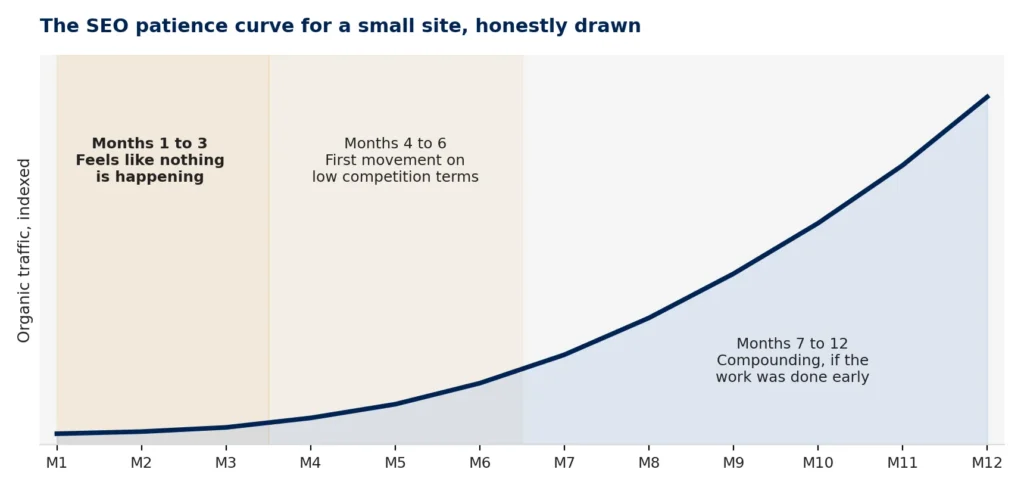
Illustrative shape of a typical first year, indexed to starting traffic. Individual sites vary with competition and starting condition.
Two honest implications. First, the fastest way to improve website SEO is rarely the most visible work, so judge progress in the early months by leading indicators, meaning impressions, indexed pages and average position, not by traffic or sales, which lag. Second, anyone promising page one in thirty days is describing either a keyword nobody searches or a method that will not survive the next update. Real timelines are the price of results that last.
When to hire help
Everything in this plan is doable by an owner with a few hours a week, and for many small sites that is genuinely enough. Paid help makes sense in three cases: a technical problem you cannot diagnose, a competitive market where depth alone is not closing the gap, or simply no hours to do the work. Before you sign anything, understand what SEO services actually include and read our candid take on whether SEO services are worth it for a business your size, because the answer is not always yes.
If you want a second pair of eyes first, that is exactly what we offer: we audit small business sites free, tell you what is broken, what is fine and what order to fix things in, and you keep the list whether you hire us or not. See our services for what working together looks like, or get a free SEO audit and call (949) 518-3350.
Frequently asked questions
How do I improve my website SEO?
Work in order: fix technical basics so Google can crawl and index the site, deepen the pages that already get impressions, add internal links from strong pages to important ones, then create new content for genuine gaps. This order exists because each stage multiplies the next.
What are the fastest SEO quick wins for a small website?
Rewrite titles on pages ranking in positions 8 to 20 in Search Console, answer the search query directly in the first paragraph, fix indexing errors, add FAQ sections to service pages, and compress oversized images. Each takes under an hour and improves pages Google already knows.
How long does an SEO improvement plan take to show results?
For most small websites, first movement appears in three to six months, with compounding gains in months seven to twelve if the early work was done properly. Judge the early months by impressions and average position, not traffic, which lags behind.
Do backlinks still matter for small website SEO?
Yes, but later than most owners think. Small sites usually lose on content depth and technical basics before authority becomes the constraint. Earn links from relevant real sites through genuinely useful content, and never buy bulk link packages, which risk penalties.
Should I do SEO myself or hire an agency?
Start yourself: the fundamentals are learnable and doing them builds judgment. Hire help when you hit a technical problem you cannot diagnose, a market where depth alone is not closing the gap, or a genuine shortage of hours. A free audit is a low risk way to find out which situation you are in.