


| Quick answer Technically yes, YouTube is social media: users create the content, follow creators and interact publicly. In practice it behaves like a search engine with a social layer on top. Most long form YouTube views come from search and recommendations serving an intent, not from a following scrolling a feed. The classification matters because it changes how you should use it. Treat YouTube like Instagram and you will burn out posting into silence. Treat it like Google, where one good answer works for years, and it becomes the highest leverage channel a small team can run. |
Marketers argue about whether YouTube is considered social media as if it were trivia. It is not trivia, it is a budgeting question. The platforms you call social get judged on social numbers, posting frequency, engagement, follower growth, and those are the wrong measures for YouTube. Where you file a channel decides how you fund it, staff it and judge it, which is exactly the kind of decision our social media strategy guide is built around.
Table of Contents
So this piece gives you the honest classification and, more usefully, what changes once you accept it. If you are still deciding which platforms deserve your limited hours at all, start with the best platform for your business and come back; YouTube usually enters that conversation with the wrong expectations attached.
The technical answer and why it is unsatisfying
By every textbook definition, YouTube qualifies as social media: user generated content, public profiles, comments, subscriptions, sharing. Case closed, and completely unhelpful. The definition tells you what YouTube is made of, not how attention moves through it, and attention flow is the only thing a marketer actually needs to understand.
On a feed platform, attention flows from your followers outward: you post, your audience sees it in a scroll, the algorithm shows it to more people if they react fast. On YouTube, most attention for long form video flows from a question inward: somebody wants something, searches or gets recommended a video that serves the want, and watches. The person does not need to know you exist. That is not how social media works. That is how Google works.
YouTube as the second largest search engine
People call YouTube the second largest search engine after Google itself, and while the claim is hard to measure precisely, the behaviour behind it is real: billions of searches happen on YouTube monthly, and Google embeds YouTube results in its own search pages. How to fix, how to choose, is X worth it, what does Y cost: buying and learning questions get typed into YouTube constantly, in every niche, including yours.
For a small business this is the entire opportunity. Search traffic is intent traffic: the viewer arrived because they want the thing you know about, today. A video answering how much does kitchen remodeling cost will be found by people planning kitchen remodels, this month and for the next three years. No feed post you will ever publish can make that promise.
Feed content versus evergreen content
The distinction that unlocks everything: feed content and evergreen content age completely differently, and each platform leans heavily one way.
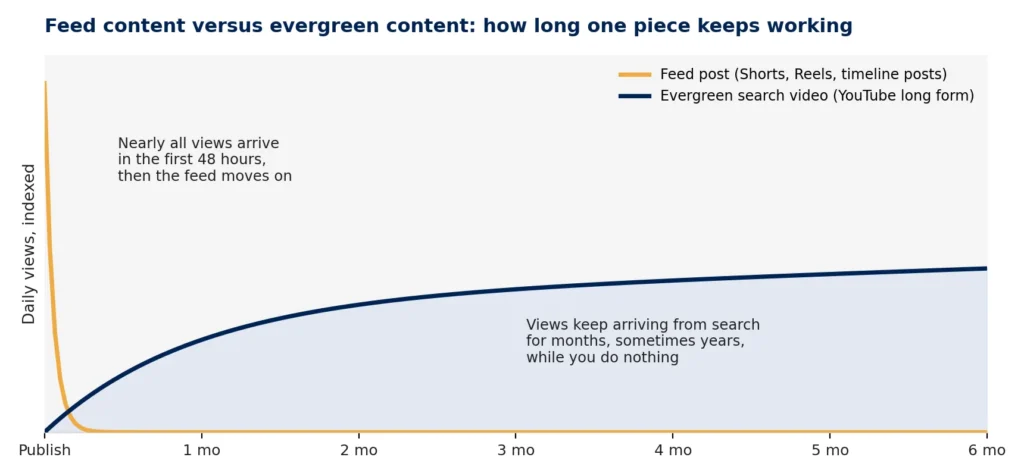
Illustrative lifespan of one piece of content on each model. The area under the curves is the point: evergreen wins on total views by doing nothing.
A feed post is a firework: nearly all of its views arrive within a day or two, then the feed moves on and the post is functionally dead. An evergreen search video is an asset: it starts slow, gets found, and keeps collecting views from search for months or years while you do nothing. One is rented attention, the other is owned.
Neither model is wrong, but they cannot be judged by the same numbers. A feed post that gets 300 views in 48 hours and dies performed exactly as designed. A search video with 300 views in 48 hours might collect 30,000 over two years. Judge the second by the first’s rules and you will cancel your best channel three months early.
Shorts: the social half of YouTube
Shorts complicates the answer, honestly. Shorts is YouTube behaving exactly like social media: a vertical feed, algorithmic distribution, fast decay, discovery driven by reaction rather than intent. Everything in our social media best practices guide applies to Shorts, and almost none of it applies to long form. One platform now runs both attention models side by side, which is why blanket advice about YouTube is usually half wrong whichever half you take.
The strategic use of Shorts for a small business is as a front door: short clips carry your face and your topic into the feed, and the channel converts a slice of that passing attention into subscribers who then watch the long form library. Shorts alone build reach without depth; long form alone builds depth that nobody discovers. The pairing is the machine.
Why the classification changes your strategy
| Decision | If you treat YouTube as social | If you treat it as search |
|---|---|---|
| What you make | Frequent, topical, reactive posts | Fewer videos answering evergreen questions |
| How often | Several times weekly, or the algorithm forgets you | When you have a real answer, even monthly |
| What you measure | Views in 48 hours, engagement rate | Views at 6 and 12 months, search traffic, leads |
| Titles and topics | Trends, hooks, whatever is moving | The questions customers actually type |
| When you quit | After a quiet month | Never for the library, it compounds |
The same platform, two opposite playbooks. Most small businesses fail on YouTube by running the left column.
Where YouTube fits for a small business
Honest fit check, because YouTube is not for everyone. It earns its place when your customers ask questions before buying, when showing beats telling, and when you can commit to a slow channel for a year. It is the wrong first channel if your sales are impulse driven, if nobody researches your category, or if the thought of a year without results ends the project in month two. The wider question of where video sits in your overall plan belongs to audience engagement strategies, but the YouTube specific answer is: it is a search asset, so fund it like SEO, not like social.
The one video a month approach
Here is the version that survives contact with a real small business schedule. One long form video a month, every month, each answering one question customers genuinely ask. Twelve videos a year sounds like nothing next to daily posting advice, and it builds a compounding library that daily posting never will. Each video also feeds everything else you publish, which is the whole logic of content marketing done properly: make one deep thing, then reuse it everywhere.
- Week 1: pick the question. Take it from real customer conversations, not keyword tools. The question you answered three times by email this month is the video.
- Week 2: script the answer in plain speech, two hundred to four hundred words. Say it like you would across a counter, then trim.
- Week 3: film it simply. A phone, a window for light, and a quiet room beat unused professional gear every time. Nerve matters more than equipment.
- Week 4: publish with a title that matches the question word for word, write a description that summarises the answer, and cut two Shorts from the best moments as the front door.
Twelve months of that and you own a small library that answers your customers’ most common questions while you sleep. If you would rather someone handled the whole cycle, that is literally a service we run: we plan YouTube as search content first, exactly as this article describes. See our services for how it works, or talk to us directly because we produce video content for clients every month. Call (949) 518-3350.
Frequently asked questions
Is YouTube social media?
Technically yes: it has user generated content, profiles, comments and sharing. In practice it behaves like a search engine with a social layer, because most long form views come from search and recommendations serving intent, not from followers scrolling a feed. The useful answer is: it is a hybrid.
Is YouTube considered social media by marketers?
Usually yes for reporting, and that filing causes real mistakes: channels judged on posting frequency and 48 hour engagement get cancelled just before their library starts compounding. Smart teams file long form YouTube under search content and only judge Shorts by social metrics.
Is YouTube a search engine or a social network?
Both, split by format. Long form YouTube works like a search engine: intent driven discovery and content that earns views for years. Shorts works like a social network: a fast feed, quick decay and reaction driven reach. Each half needs its own playbook.
What is the difference between feed content and evergreen content?
Feed content collects nearly all its views within a day or two, then dies as the feed moves on. Evergreen content starts slower but keeps earning views from search for months or years. Feed content rents attention; evergreen content builds an asset you own.
How often should a small business post on YouTube?
For long form, one genuinely useful video a month is enough, because search videos compound instead of expiring. Consistency over a year beats frequency over a quarter. Add two or three Shorts cut from each video if you want feed reach on top.